
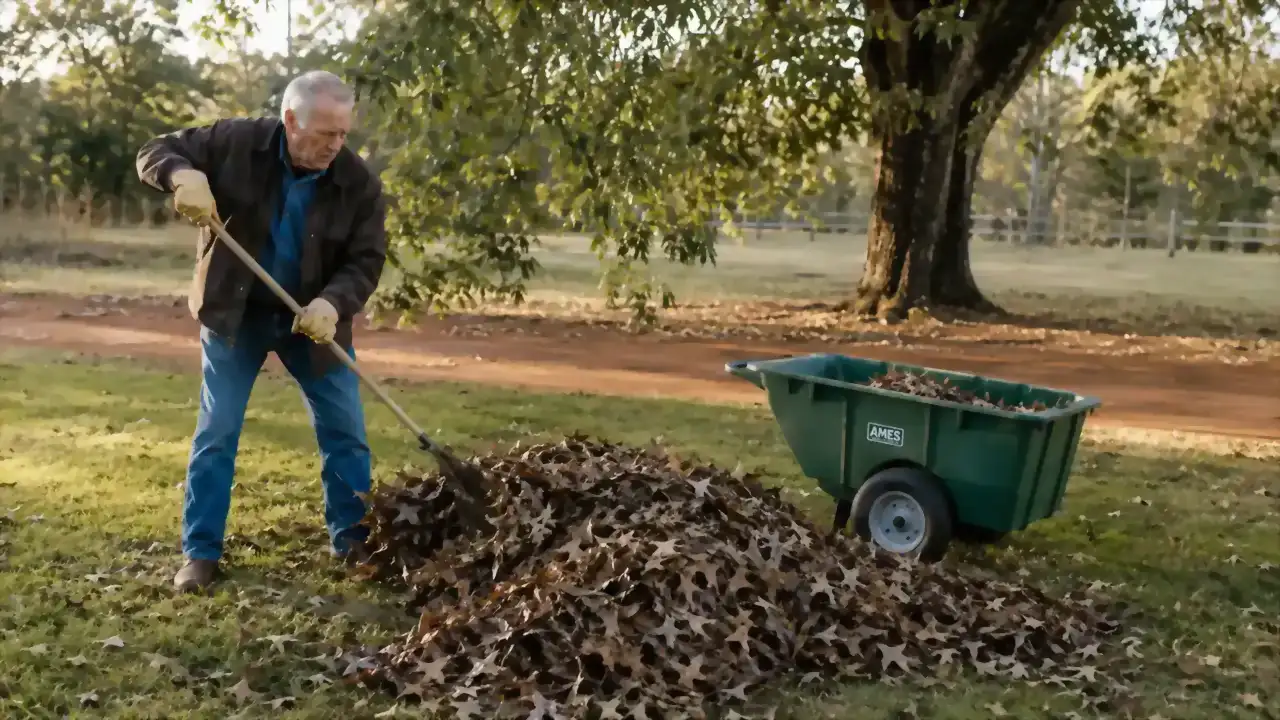
I used to think hauling mulch and leaves was just a matter of muscle. Load the cart, drag it where it needs to go, dump it, repeat until your back tells you to quit for the day. After thirty-eight years gardening this same half-acre outside Burlington, North Carolina, and two full falls of leaning on a Gorilla Carts poly dump cart to move the willow oak's leaf drop off my lawn, I've learned that the order you do things in matters almost as much as the tool itself. Load a cart wrong and even a good one fights you. Load it right and the same cart does most of the work.
None of what follows is complicated. It's the method I've settled into after enough wrong turns, tipped loads, and sore mornings to know better. If you're hauling mulch out to garden beds or clearing leaves before the red clay underneath turns to mud, this is the order I do it in, start to finish, with the Gorilla Carts doing the pulling.
I didn't work any of this out in one afternoon. It came from doing the job wrong enough times, mostly during that first fall, before I paid attention to why some loads felt easy and others felt like a fight from the driveway to the compost pile. The steps below are in the order I actually do them, not the order I'd have guessed at before I owned the cart.
The Right Cart Makes Every Step Below Easier
None of this method works as well behind a cart that tips easy or dumps hard. I do all of it with the Gorilla Carts poly dump cart. Check today's price and current rating on Amazon before you start your next haul.
Amazon Check Today's Price on Amazon →Step 1: Stage the Pile Where the Cart Can Reach It
The single biggest time waster I see, and one I was guilty of for years, is raking a pile of leaves or dumping a bag of mulch wherever's convenient and then figuring out how to get the cart to it afterward. Do it the other way. Before you rake a single leaf or crack open a bag of mulch, look at where the cart is going to sit and rake toward that spot, not away from it.
Under my willow oak that means raking leaves downhill toward the flat stretch of lawn where I can park the Gorilla Carts on level ground instead of trying to load it on the slope itself. For mulch, I have Sawyer and June help me stack the bags along the edge of the raised beds first, then bring the cart to the stack rather than carrying bags out one at a time. Staging the pile first turns loading into a five minute job instead of an hour of back and forth.
This step sounds obvious written out, but it's the one I skip when I'm rushing, and it's always the one that costs me the most extra walking by the end of the day. Two minutes of planning where the cart will sit saves twenty minutes of dragging leaves or bags across the yard later.
Step 2: Load Over the Axle, Not at the Tailgate
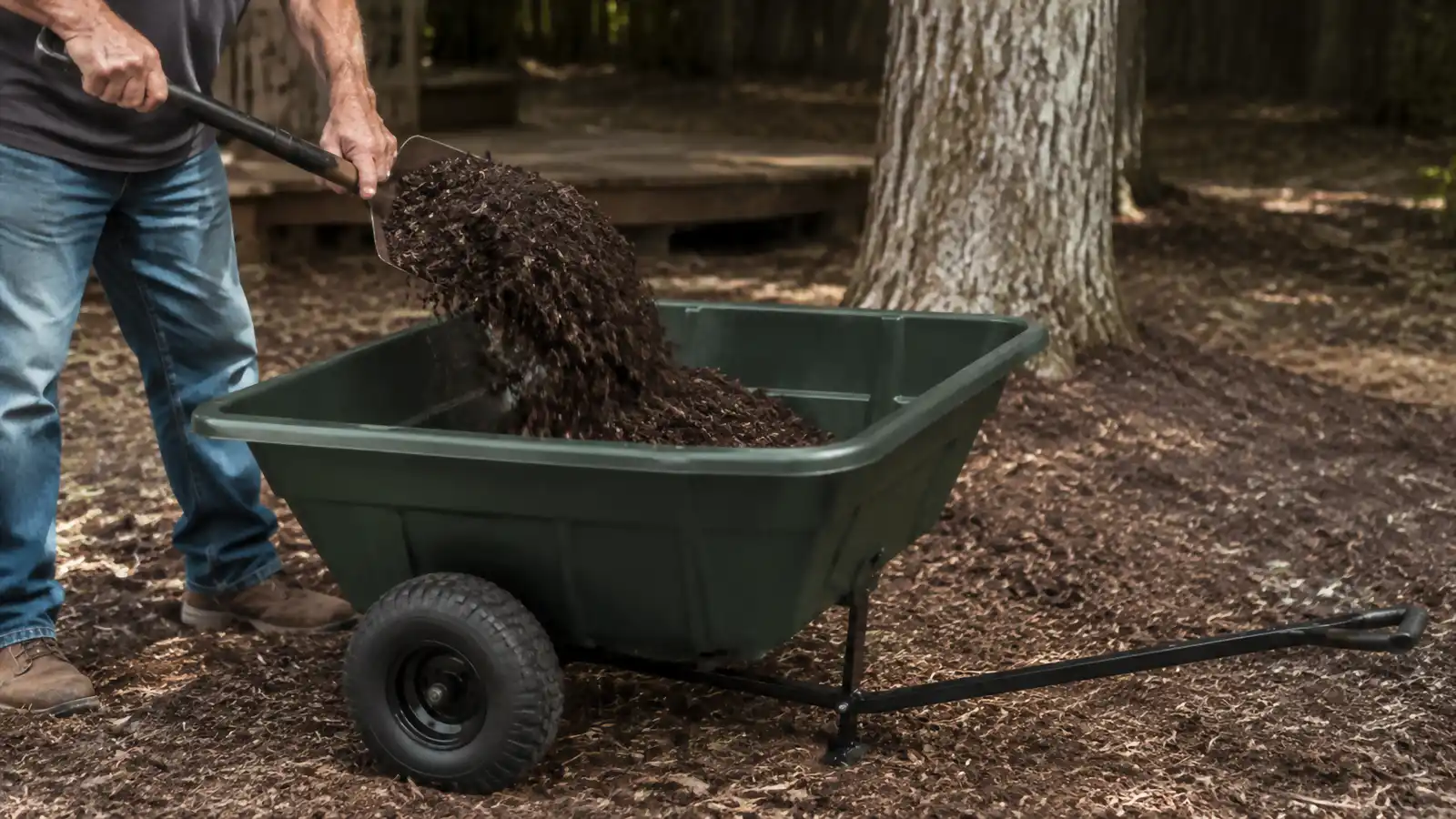
Where you put the weight inside the bed changes how the whole cart handles. I learned this one the hard way, piling mulch and leaves toward the back of the Gorilla Carts because that's the end closest to me when I'm shoveling. That's exactly backward. Weight stacked at the tailgate lifts the front wheels light and makes the cart want to fishtail the second you turn, especially with a heavy load.
Now I load over the axle, meaning I push the first few shovelfuls or the first couple of mulch bags forward, toward the center of the bed, and build the pile from there. It keeps the weight sitting directly over the wheels instead of hanging off the back, and the difference in how easy the cart pulls is noticeable within the first few feet.
It takes a little getting used to, since your instinct is to load closest to where you're standing. I still catch myself piling mulch at the tailgate on the first bag of a session before I remember and push the next few forward. Once the weight sits over the axle, though, pulling the Gorilla Carts across the yard takes noticeably less effort at the handle.
Step 3: Take Smaller Loads on the Slope
The slope at the back of my lot is where every hauling mistake I've ever made has shown up first. A full load that handles fine on flat lawn behaves completely differently once gravity gets involved, and I don't fight that anymore. On the slope, I load the Gorilla Carts to maybe two-thirds of what I'd put in on level ground.
It costs me an extra trip or two on a big cleanup day, but it means I'm never standing at the bottom of that grade wondering if the cart's about to get away from me. Two wheels set wide apart help a lot on that slope compared to the single wheel I dealt with for years, but a smaller load is still the difference between walking the cart down under control and chasing it.
I gauge it by feel more than by any measurement. If I can start the cart moving downhill with one hand still on the handle and it doesn't want to pick up speed on its own, the load's about right. If it starts rolling ahead of me the moment I let go, that's too much for the slope and I take some back off before I go any further.
Step 4: Tarp-Line the Bed for Leaves
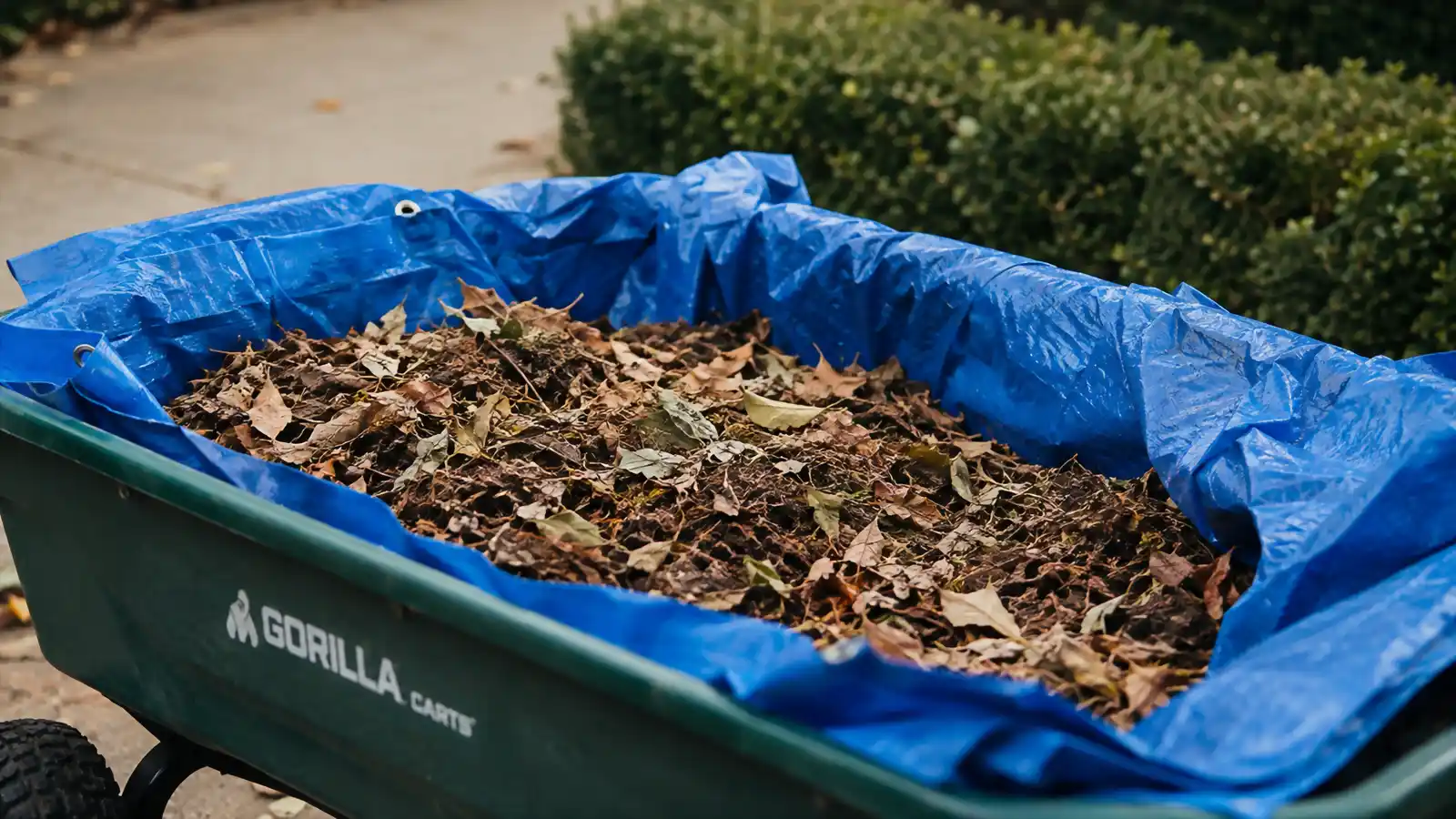
This is the one trick I wish somebody had told me the first fall I owned the cart instead of the second. Before I rake a big pile of leaves into the Gorilla Carts, I lay an old tarp inside the bed first, letting the edges hang over the sides. I rake the leaves onto the tarp inside the cart, not directly into the poly bed.
When it's time to dump, I don't rely on the cart's tilt mechanism alone for leaves, which tend to mat together and stick to the corners of a poly bed instead of sliding out clean. Instead I grab the corners of the tarp, pull the whole load out in one motion, and the leaves come out as a single bundle wherever I want them, whether that's the compost pile or the curb. It saves me from crawling into the bed to scrape out the last soggy handful every single time.
Step 5: Back the Cart Into Position Before You Dump
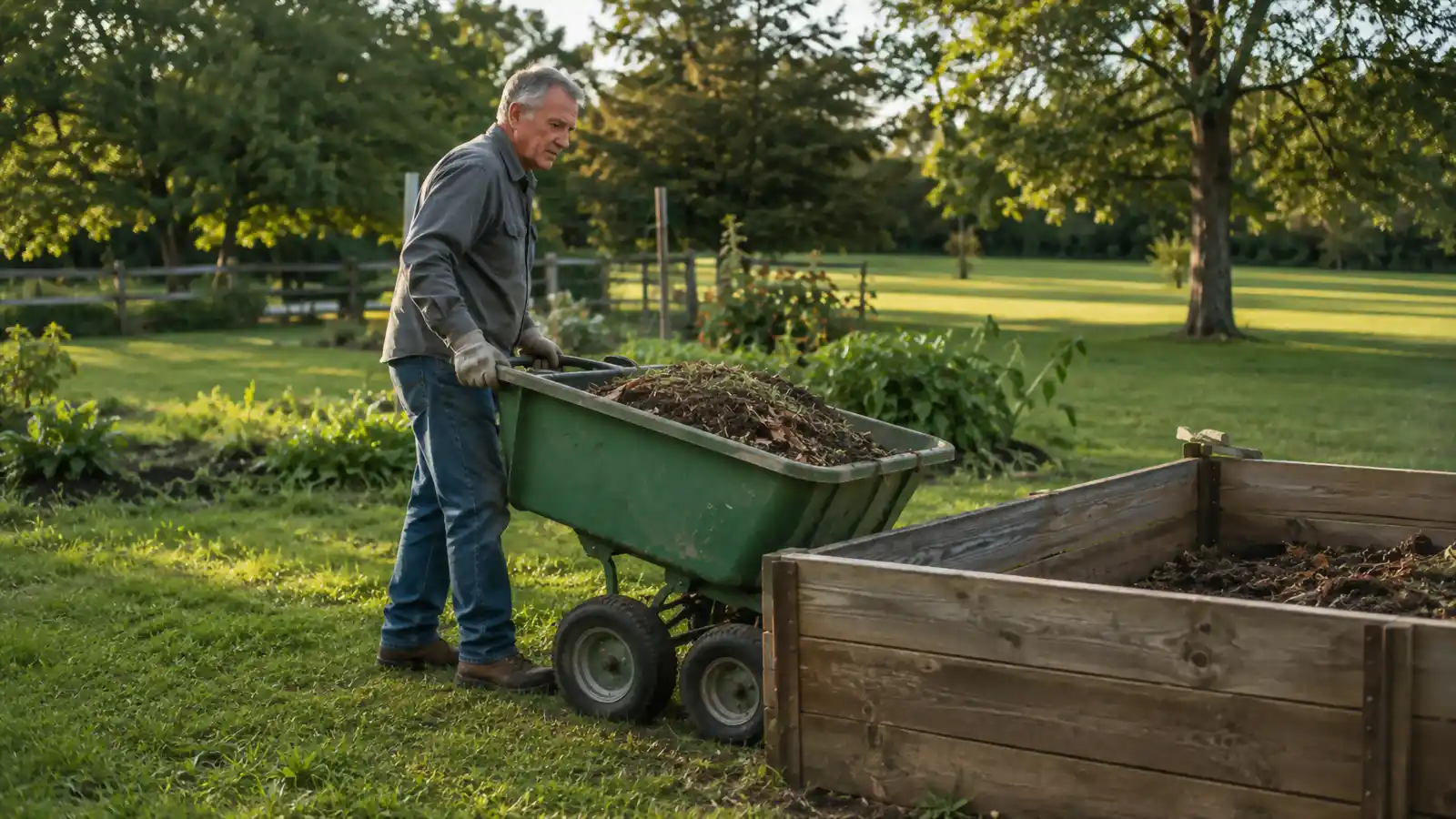
I used to pull the cart up nose-first to wherever I was dumping, then realize I had to muscle the whole thing around afterward to get the release lever facing the right direction. Now I back the Gorilla Carts into position before I ever touch the dump lever, the same way you'd back a trailer up to a spot rather than trying to maneuver it in after the fact.
This matters most at the raised beds Delia and I built back in 2019, where there's not much room to swing a loaded cart around once it's sitting where you want it. Backing in first means the load tips exactly where I need it the first time, instead of me shoveling it another six feet after the fact because the cart landed at the wrong angle.
It's a small habit, but it's saved me a lot of double handling. The first fall I owned the cart, I probably re-shoveled a third of every load I dumped just because the cart landed pointed the wrong way. Backing in first fixed that almost entirely.
Step 6: Spread Mulch by Pulling It Down the Bed With a Rake
Once the Gorilla Carts is backed into position at a bed and the release lever tips the mulch out, don't shovel it a second time to spread it. I did that for longer than I'd like to admit, dumping a pile and then shoveling scoop after scoop out to the edges of the bed. It's twice the work for the same result.
Instead, tip the load out along one edge of the bed and use a garden rake to pull the mulch across the surface, the same motion as raking leaves flat. The cart already did the hauling. Let the rake do the spreading. It cuts the whole job down by a good third of the time it used to take me, and it's easy enough that Sawyer can do the raking part while I move the next load.
It works best when the cart lands close to the bed rather than several feet back, which is another reason backing into position in the step before this one matters. A short pull with the rake beats a long drag every time.
Step 7: Rinse the Bed Before Wet Mulch Sets
The last step is the one that's easiest to skip and the one I'd tell you not to. Wet mulch left sitting in a poly bed overnight starts to cling to the sides and bottom, and by the next morning it takes a lot more scraping to get loose than it would have taken a garden hose the evening before.
After the last load of the day, I run the hose over the Gorilla Carts bed and give it a quick scrub with a stiff brush before rolling it back into the shed. It's maybe two minutes of work, and it's kept the poly bed looking close to new across two full seasons of hauling mulch and wet leaves. Skip it a few times in a row and you'll spend a Saturday morning chiseling dried mulch off the bottom of the bed instead of gardening.
What Else Helps
Beyond the steps above, a few habits have made hauling easier without any extra equipment. I keep the Gorilla Carts staged near whichever part of the yard I'm working in that week instead of always rolling it back to the shed between loads, since half the effort of any big hauling day is just the walking. I also check tire pressure before a heavy fall cleanup starts, since a soft pneumatic tire drags noticeably on the red clay path behind the house. And I've stopped fighting wet weather. If the leaves or mulch are soaked through, I take smaller loads and accept a few extra trips rather than pushing a cart to its limit on ground that's already soft.
I've also found it helps to plan the route before I start pulling, especially on cleanup days when I'm making a dozen trips or more. I pick one direction to travel and stick with it rather than zigzagging across the yard, which keeps me from crossing my own path with the boxwood hedge or the shed door in the way. It's a small thing, but on a day with fifteen loads to move, a straight route adds up to a lot less walking by the end of it.
I go into the cart itself in more detail in my long-term review after two full falls of use, and if you're still deciding whether a dump cart is worth adding to your shed at all, I laid out the specific reasons this one earns its keep on my lot in 10 reasons a garden dump cart earns its keep.
The first fall I owned it, I fought the cart almost as much as I fought the leaves. The second fall, once I had the order right, the cart did the fighting and I just walked alongside it.
Get the Cart That Makes This Method Work
Every step above assumes a cart that dumps clean and tracks straight on uneven ground. That's been my experience with the Gorilla Carts across two full falls of leaves and mulch. Check today's price and current rating on Amazon.
Amazon Check Today's Price on Amazon →