
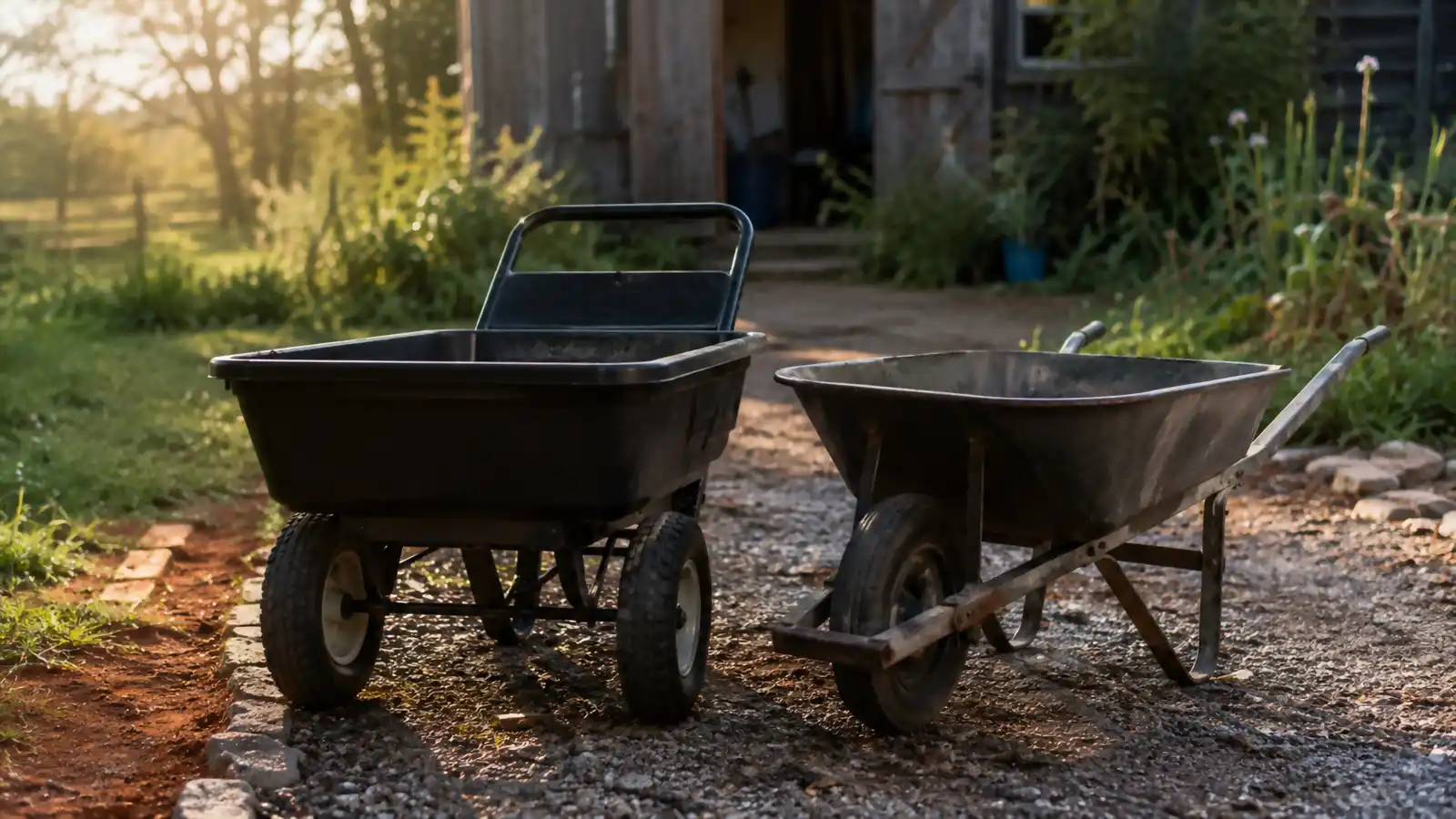
I pushed a wheelbarrow around this half-acre outside Burlington for thirty-five years before a Gorilla Carts dump cart ever showed up on my pegboard. That matters for this comparison, because I am not writing this as someone who fell in love with a cart and forgot what a wheelbarrow does well. I still own a wheelbarrow. It hangs on the back wall of my 10x12 shed, tipped up on its nose, and I reach for it more than you might guess. The Gorilla Carts dump cart lives out by the raised beds most of the season, and the two of them split the work on this property depending on what the job actually calls for.
So this is not a piece arguing that a Gorilla Carts dump cart replaces a traditional wheelbarrow outright. It does not, and anyone who tells you a two-wheel cart is a straight upgrade in every situation has probably not hauled a full load of gravel down a narrow path between two raised beds. What I can tell you is where each one earns its keep on red clay, on a slope, and on the flat stretch by the drive where Delia keeps her boxwoods trimmed.
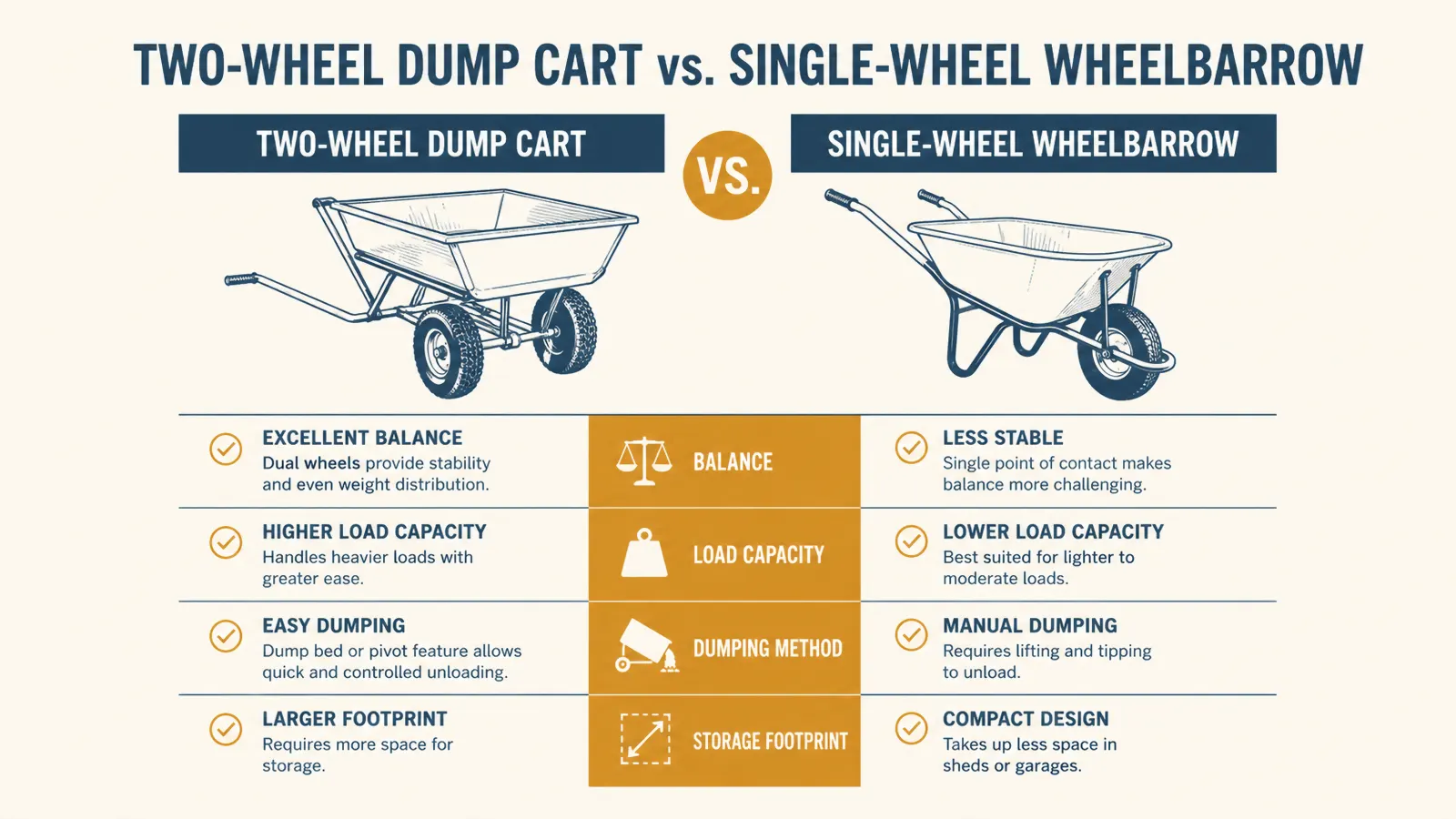
| What Matters | Gorilla Carts Dump Cart | Traditional Wheelbarrow |
|---|---|---|
| Balance when loaded | Two wide wheels plus a stand, sets itself down level, no arm strength needed to keep it upright | One wheel, you hold the whole load level with your grip |
| Heavy loads on flat ground | 300 lb capacity carried on two wide tires, tracks straight | Weight rides on one wheel and your arms, tires faster with heavy loads |
| Tight spots between raised beds | Wider stance, needs a real path to get through | Narrow footprint, threads between beds with room to spare |
| Dumping the load | Pull the release, the bed tips forward on its own | You lift and tip the whole barrow by hand |
| Rough or sloped ground | Both wheels need contact, can bind up on uneven turf | One wheel rolls over roots and ruts more easily, pivots around obstacles |
| Out of the box | Wheels, axles, and tow handle to bolt on before first use | Little to no assembly, ready to push |
| Hauling multiple loads in a row | Pull with your legs, not your lower back, less fatigue over a long afternoon | Every trip works your forearms and grip the same way |
| Storage footprint | Sits flat on its wheels and stand, takes up floor space in the shed | Stands up on its nose against a wall, small footprint |
Where the Gorilla Carts Dump Cart Wins
The first time I loaded the Gorilla Carts dump cart with a full run of mulch, I set it down mid-path to catch my breath and it just sat there, level, waiting on me. That never happened with the wheelbarrow. Set a loaded wheelbarrow down wrong and it either tips or you spend the next thirty seconds finding a spot flat enough to rest it on its own. The two wide wheels on the Gorilla Carts cart carry the weight the whole time, not your grip, which means you can stop, wipe your forehead, and pick it back up without fighting gravity to get it balanced again. It sounds like a small thing until you have done it forty times in one Saturday.
That balance shows up most on the long hauls. I move a lot of material from the drive back to the raised beds I built in 2019, and it is close to eighty yards each way on flat ground. With the wheelbarrow, that eighty yards was an arm and shoulder job, every trip. With the Gorilla Carts dump cart, I pull the tow handle with my legs and my back stays out of it almost entirely. At seventy-one, that difference is not a small one. My grandson Sawyer, who is nine, can even help pull it partway loaded, something he never had the strength to do with the wheelbarrow.
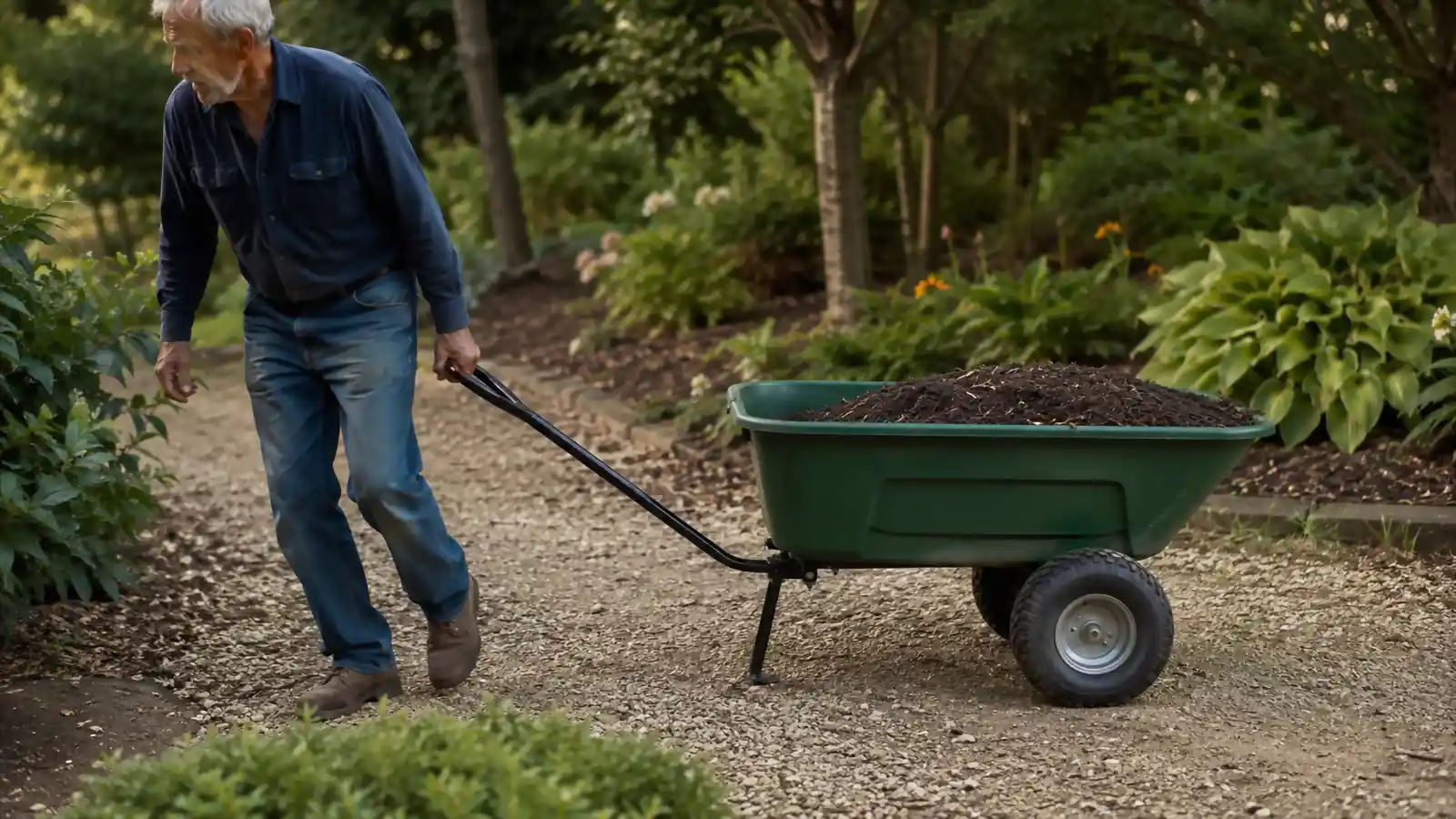
The dumping is where the Gorilla Carts name earns itself. There is a release lever at the front of the bed, and when you pull it the poly tub tips forward and empties itself. I do not lift anything. That matters more than people expect until they have shoveled a full load of wet leaves out of a wheelbarrow by hand at the end of a long Saturday. The Gorilla Carts cart just tips, the pile drops where I want it, and I latch the bed back down and go get the next load.
The cart that took the lifting out of hauling.
The Gorilla Carts poly dump cart holds up to 300 lbs on two wide tires and empties itself with one pull of the dump release. Rated 4.6 stars by more than 3,200 Amazon customers.
Amazon Check Today's Price on Amazon →Where a Traditional Wheelbarrow Wins
I am not going to pretend the wheelbarrow is obsolete on this property, because it isn't. The path between my two raised beds is narrow enough that the wider stance of the Gorilla Carts dump cart genuinely does not fit through without me tipping it up on an angle and forcing it. The wheelbarrow, with its single wheel out front, slides through that same gap without any fuss. Anyone with a garden laid out in tight rows knows exactly what I mean. A two-wheel garden cart wants a real path. A wheelbarrow just wants a wheel's width.
The slope at the back of my lot is the other place the wheelbarrow still gets picked. One wheel can find its own line over a root or a rut, and you can pivot the whole thing around an obstacle almost in place. The Gorilla Carts dump cart needs both wheels tracking together, and on soft or uneven turf that can mean it binds up or drags where a single wheel would have rolled right over. There is also nothing to assemble with a wheelbarrow. It comes off the shelf ready to push, while the Gorilla Carts cart asked for a wrench and about twenty minutes with the wheels, axles, and tow handle before its first trip out of the shed.
A wheelbarrow goes anywhere a footpath goes. A Gorilla Carts dump cart hauls more, dumps itself, and asks for a real path in return. Neither one is wrong. They are built for different stretches of the same yard.
What Actually Breaks First
I have owned enough wheelbarrows to know what fails on them. It is almost always the tire. The cheap ones lose air within a season and the good ones with solid rubber still crack after enough years in the sun. The steel tray holds up fine, but a flat tire turns a wheelbarrow into dead weight in the shed until you deal with it. The poly bed on the Gorilla Carts dump cart will not go flat, and it shrugs off rust the tray of an older wheelbarrow eventually shows. That said, a poly bed is still plastic, and I would not want to drop a load of broken concrete or sharp fieldstone into it from any height. A steel wheelbarrow tray takes that kind of abuse better than a poly bed ever will.
Cold weather is the other honest concern with the poly bed. We do not get brutal winters here in the Piedmont, but I have left the Gorilla Carts cart out overnight on a hard frost more than once, and plastic gets brittle in a way steel does not. I try to bring it into the shed once the temperature really drops, mostly out of habit from watching plastic totes crack in the cold over the years. The wheelbarrow never needed that kind of thought. Steel does not care what the thermometer says. It is a small point of maintenance, but it is a real one, and I would rather name it than pretend the poly bed is bulletproof.
The other honest point goes to the wheelbarrow on simplicity. There is less to a wheelbarrow that can go wrong in the first place. One wheel, one tray, two handles. The Gorilla Carts dump cart has two wheels, an axle assembly, and a dump release mechanism, which is more moving parts by design. Mine has held up fine through two full seasons of regular use, but if you want the tool with the fewest parts to ever need attention, that is the wheelbarrow's whole argument.
How I Decide Which One to Grab
On a normal Saturday I am hauling mulch or leaves from the drive to the beds, or pulling a load of clippings out after Delia and I trim the boxwoods, and the Gorilla Carts dump cart comes off its spot by the shed door without me thinking twice. Anyone who wants the full story on that day-to-day use can read what I found in my honest review of the Gorilla Carts dump cart, where I get into the assembly and the first few months of hauling in more detail.
The wheelbarrow comes down off the wall when the job is small, narrow, or off the flat path entirely. A single trip of soil for one pot near the porch, a run along the back slope where the ground is soft, or anything that needs to squeeze between the raised beds. It is also what I grab if June, my six-year-old granddaughter, wants to help move something light. It is easier for her to steady a wheelbarrow's single wheel over a short, slow trip than to manage the wider stance of the cart. For a longer look at how the Gorilla Carts cart has held up across two seasons of that kind of split use, I wrote up what two seasons of regular hauling with it actually looks like.

Who Should Buy Which
If most of your hauling is heavy and happens on relatively open, flat ground, mulch runs, leaf cleanup, moving bagged soil from the drive back to the beds, the Gorilla Carts dump cart is the one worth owning. The balance alone changes how much of the work lands on your back instead of your legs, and the dump release saves you the shoveling at the end of every trip. If your yard is tight, sloped, or laced with narrow paths between beds and borders, keep a traditional wheelbarrow in the shed too. Mine earns its spot on the wall for exactly those jobs, and I would not give it up.
Most gardens I have seen, including my own, end up better served by having both than by picking one and retiring the other. The Gorilla Carts dump cart handles the bulk of the heavy, repetitive hauling that used to wear on my back and shoulders. The wheelbarrow handles the narrow, awkward, occasional jobs the cart was never built for. Neither one makes the other obsolete, and after two seasons of running both, I am not looking to change that arrangement.
Less lifting, more hauling, one pull to dump.
The Gorilla Carts poly dump cart is rated 4.6 stars across more than 3,200 Amazon reviews. If your hauling is mostly on flat, open ground, this is the tool that takes the strain off your back.
Amazon Check Today's Price on Amazon →