
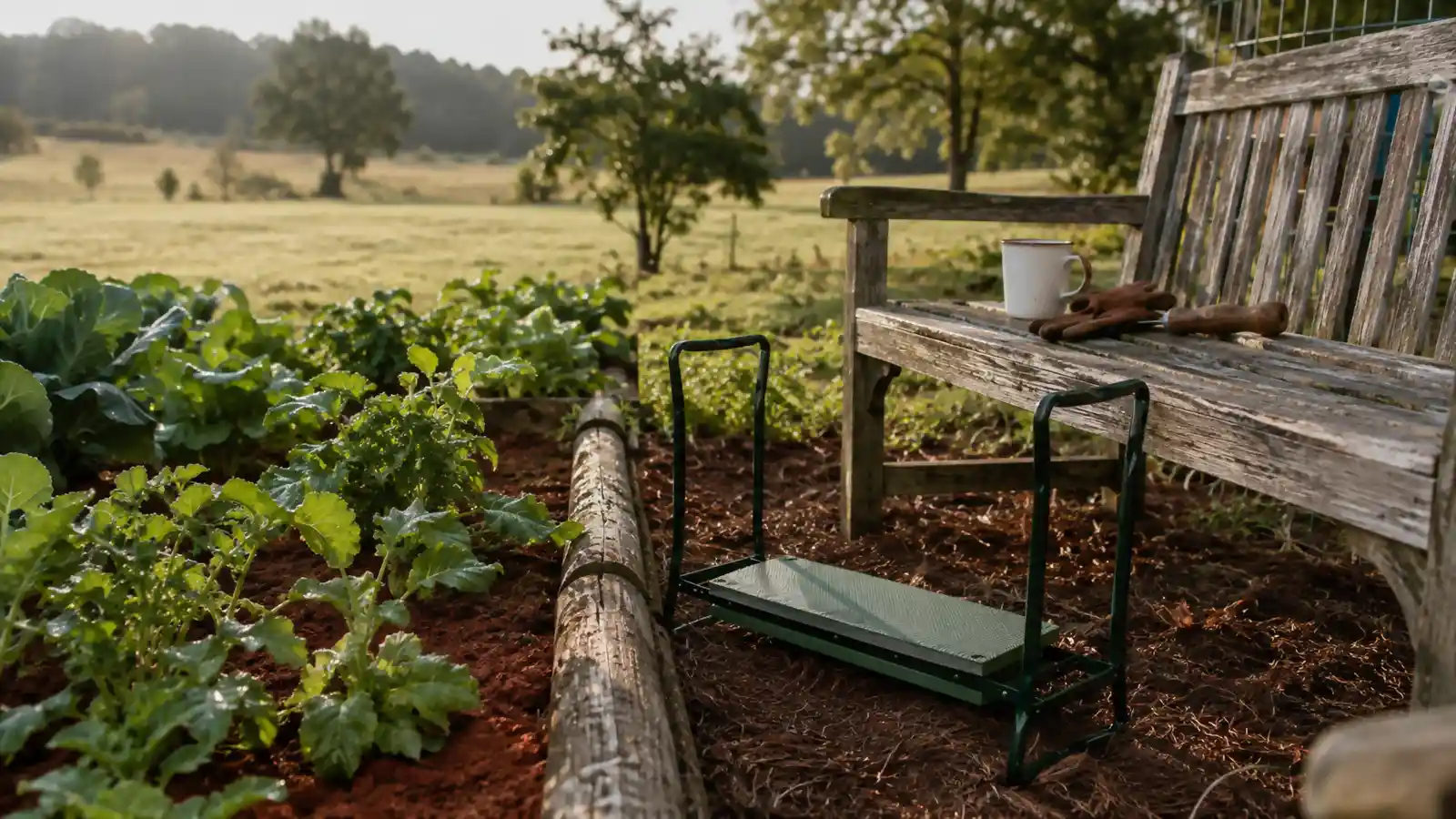
If you want the short answer, here it is: the KVR Upgraded Garden Kneeler and Seat is the tool I actually reach for on a real weeding afternoon, and a plain wooden garden bench is the one that looks nicest sitting empty at the head of the raised beds. I own something close to both. Delia's father built us a simple cedar bench years ago, the kind you can still find at almost any garden center, and it has sat at the end of my two raised beds since 2019. The KVR kneeler has lived on a hook in my 10x12 shed for less time than that bench, but it gets pulled down far more often. This is not a piece where one tool loses and the other wins across the board. They solve different problems, even though shoppers compare them constantly, so let's be honest about both.
A wooden bench earns its keep by being pretty and permanent. Ours sits at the end of the tomato rows year-round, and my grandkids Sawyer and June climb on it more than I sit on it most weeks. The KVR kneeler earns its keep by going wherever the actual work is, down along the boxwoods, up at the raised bed rim, out by the willow oak where the roots buckle the ground. Neither one replaces the other completely on my half-acre. But if I had to keep just one, the KVR wins, and the table below shows exactly why.
| What Matters | KVR Kneeler and Seat | Wooden Garden Bench |
|---|---|---|
| Flips to a seat | Yes, turn it over and it becomes a stable bench with handles | No, it is built and used as a seat only |
| Kneeling pad comfort | Thick foam pad, close to 1.5 inches, cushions knees directly on the ground | No kneeling function at all, you sit above the bed instead |
| Built-in tool storage | Two side mesh pouches for a trowel and gloves | None, tools have to be carried separately |
| Folds for storage | Yes, folds flat and leans against a shed wall | No, fixed size, stays wherever you place it |
| Looks in the garden | Powder-coated steel and foam, plainly a piece of equipment | Cedar weathers to silvery grey, genuinely handsome as furniture |
| Assembly and moving parts | Ships assembled, but has a folding hinge that gets used constantly | Built once, no hinge, nothing mechanical to work loose |
| Carrying it across the yard | Light enough to fold and carry one-handed to wherever the work is | Heavy and stationary, not meant to be moved often |
| Stability on uneven red clay ground | Wide steel legs sit reasonably flat on sloped or uneven soil | Solid wood legs are steady too, as long as the ground is level |
Where the KVR Kneeler and Seat Wins
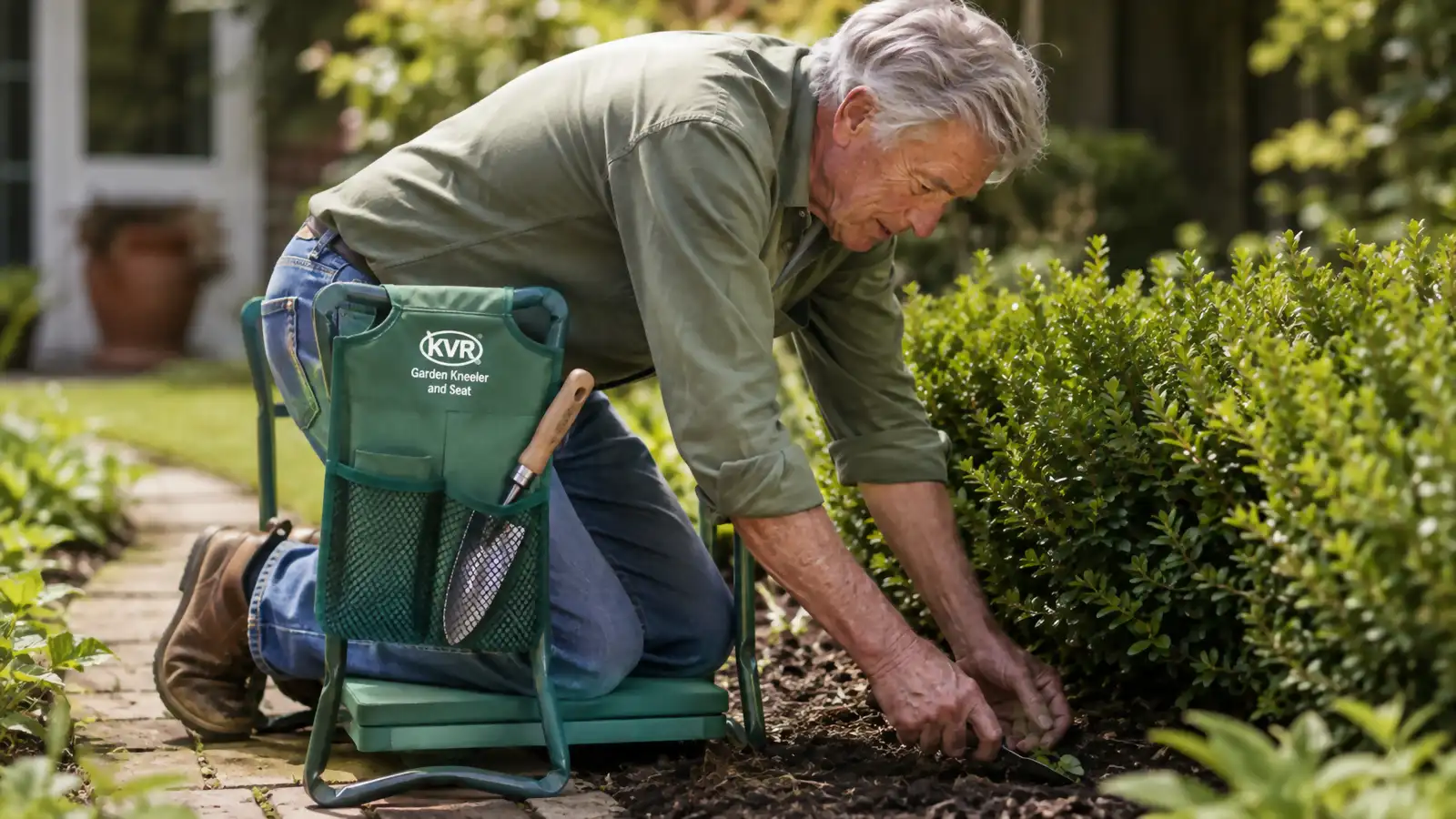
The single feature that changed how I garden is the flip. When my knees have had enough of being down in the dirt along the boxwoods, I turn the KVR kneeler over and it becomes a seat with two carrying handles I can hold onto to steady myself standing back up. A wooden bench does not do that. It sits at one height, the height someone built it at, and if you need to be down at ground level pulling weeds instead of sitting six inches up, the bench just is not built for that job. The KVR frame is powder-coated steel with a thick foam kneeling pad, close to an inch and a half, and after a full spring of weeding the two raised beds I built back in 2019, my knees noticed the difference within the first week.
The two tool pouches sewn into the sides of the KVR are the other thing I did not expect to matter as much as it does. I keep my hand trowel in one and a pair of gloves in the other, and I am not walking back to the shed three times an afternoon anymore. When I am done, the whole thing folds flat enough to lean against the wall next to my pegboard, which matters in a 10x12 shed where floor space is not something I have much of. A wooden bench does not fold. It sits where you put it, in rain or shine, taking up the same footprint whether you are using it that week or not.
Where the Wooden Garden Bench Wins
I would be lying if I said the bench does not win on looks. Ours has gone silvery grey after years outside, and it fits the garden the way a folded steel kneeler with mesh tool pouches never will. It sits at the head of the raised beds like it belongs there, and more than one neighbor has asked where Delia's father got it. The KVR is a plainly functional tool, and it looks like one. Nobody has ever asked where I got my garden kneeler. If you want something that reads as furniture rather than equipment, a wooden bench does that job in a way no folding kneeler ever will, no matter how good the foam pad is.
The bench also asks nothing of you once it is built. There is no folding hinge to work loose, no foam pad to eventually compress, nothing mechanical at all. Ours has sat at the end of the tomato rows through years of North Carolina summers without a single repair, just an occasional coat of sealant Delia insists on every couple of years. A KVR kneeler, like anything with moving parts and a padded surface, will eventually need the pad replaced or the hinge checked. That is the tradeoff for all the functionality. A bench has almost nothing to fail because it has almost nothing to it beyond four legs and a seat.
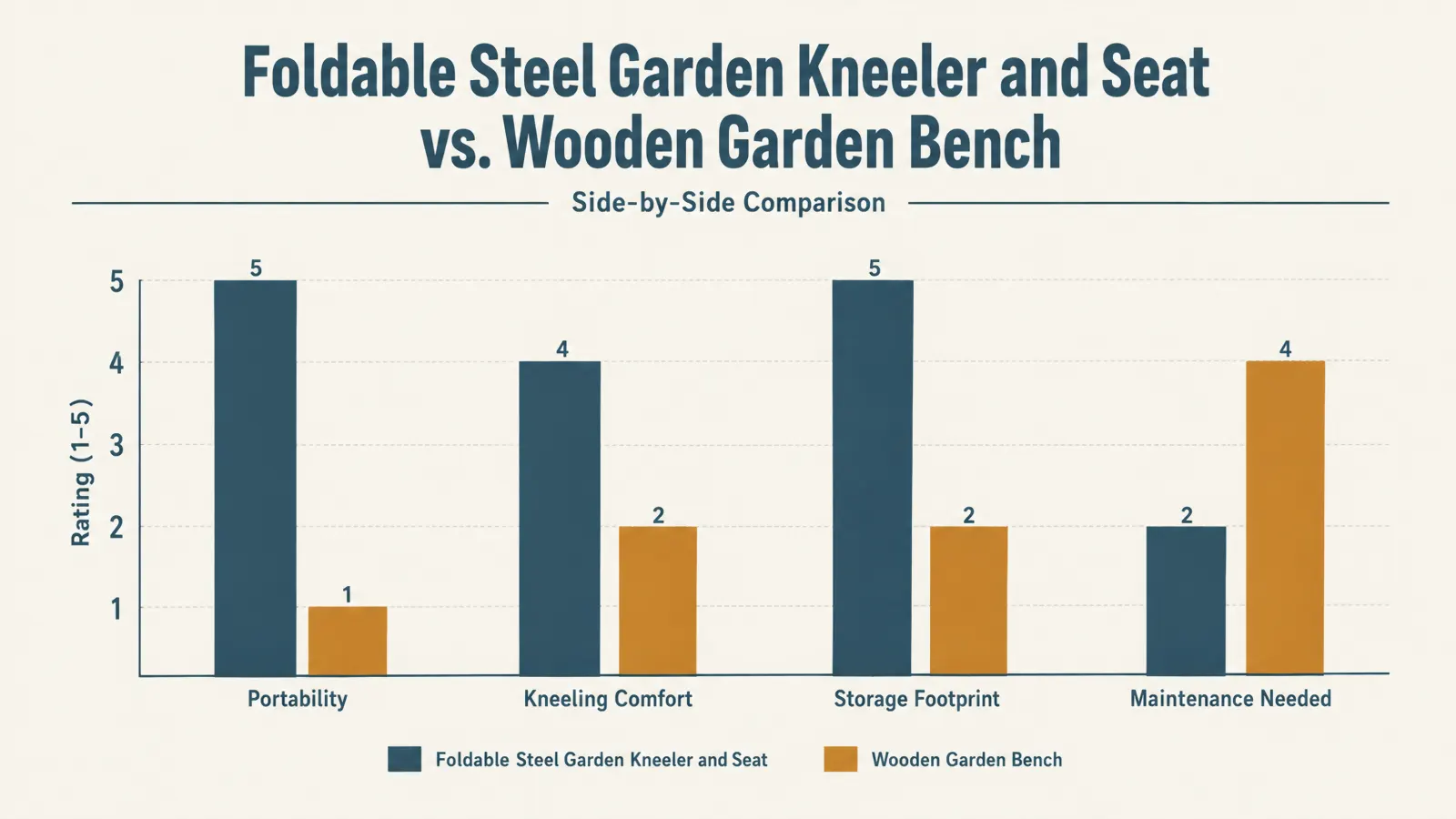
A bench looks like it belongs in the garden. A kneeler works like it belongs in the garden. Only one of them actually gets down in the dirt with you.
The tool that actually gets down where the weeds are.
The KVR flips from a padded kneeler to a stable seat in one motion, with two tool pouches built in so you are not walking back to the shed all afternoon. Rated 4.7 stars by more than 4,000 Amazon customers.
Amazon Check Today's Price on Amazon →What Actually Fails First
If you are weighing durability, it helps to know what actually goes wrong with each one over years, not just the first season. The wood on a bench like ours needs re-sealing every couple of years or the grain starts to check and split, especially with the humidity we get outside Burlington. Skip that maintenance long enough and a board can eventually crack under weight, though ours has held up fine with Delia keeping after it. The KVR's failure point is different. The foam pad compresses over years of kneeling, and eventually you will want a replacement pad or a folded towel underneath for extra cushion. Mine is still holding up fine, but I know that pad is the part that will wear first, the same way a blade wears on a pair of shears.
Neither tool fails fast. Both are the kind of thing you buy once and expect to get years out of. But a wooden bench fails slowly and visibly, a board grays and eventually splits, while the KVR fails quietly, a pad that gets a little flatter each season until one day you notice your knees are working harder than they used to. Knowing which failure mode you are more likely to catch and fix matters more than most buyers realize before they own either one.
How I Actually Use Each One Through a Season
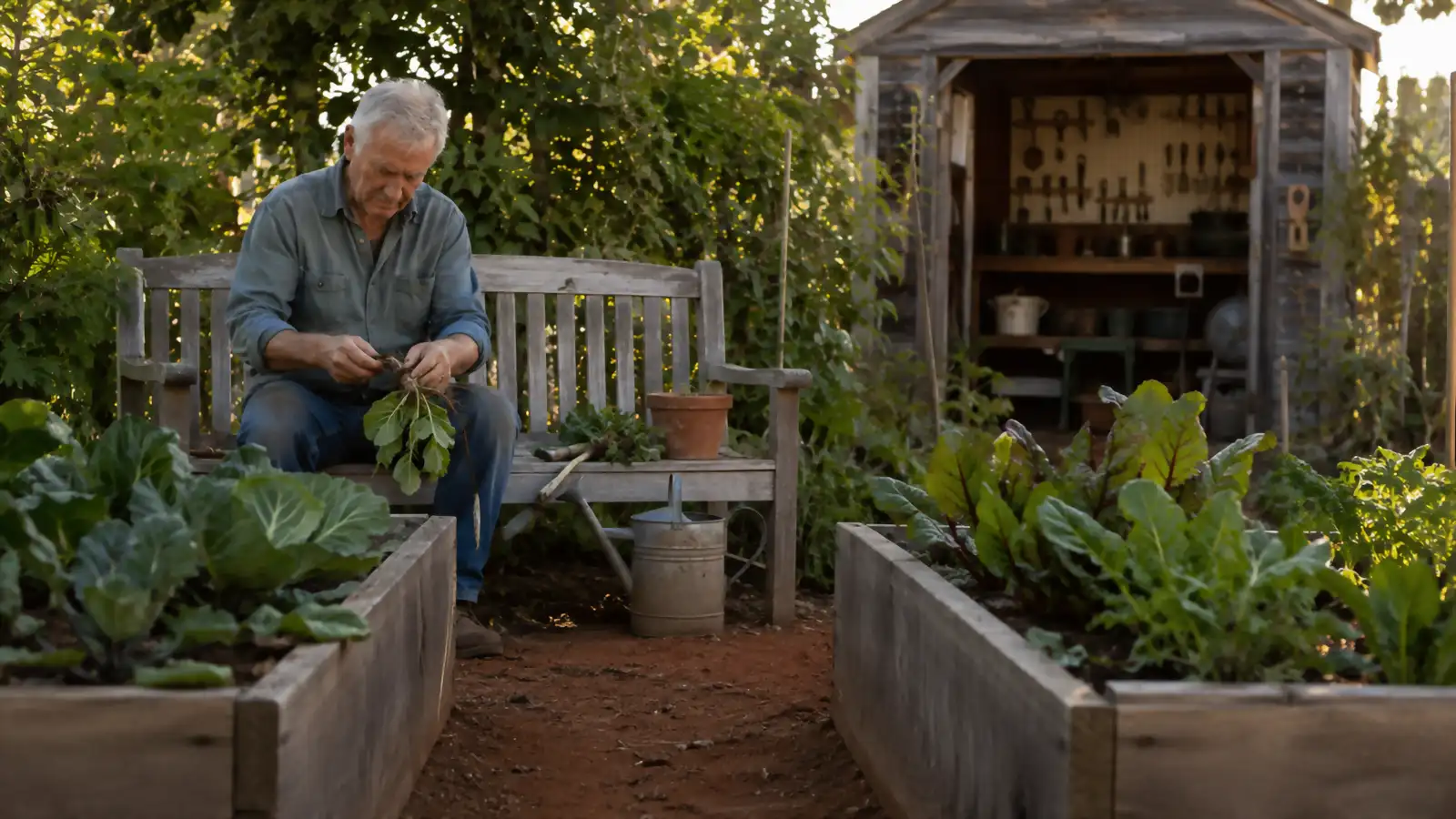
By late spring, I have usually used the KVR kneeler more in a single month than I use the bench in three. March and April are when the two raised beds get turned over, when the boxwood bed gets its first real weeding, and when I am down on my knees more than any other stretch of the year. That is exactly the window where the KVR earns its keep, because I can drag it along the row as I go, flip it to a seat when my knees need a break, and keep moving without walking anywhere. The bench, by contrast, gets used most in June and July, in the evenings, when the hard planting work is done and what is left is just checking on things. Delia and I will sit out there most evenings that time of year with a glass of tea, watching June chase fireflies near the willow oak, and that is a job the KVR was never built to do and the bench does perfectly.
By November, when I am cutting back the last of the perennials and getting the beds ready for winter, the KVR goes back on its hook and stays there until March. The bench never comes inside. It sits out through every North Carolina winter we have had since 2019, rain, frost, the occasional light snow, and it is still standing there every spring without me having done a thing to it beyond that occasional coat of sealant. That difference alone tells you something about what each tool is actually for. One is seasonal equipment I put away when the work is done. The other is a permanent fixture I built the garden around. Comparing them on a single spec sheet misses that they occupy two completely different roles in how the year actually unfolds out here.
Who Should Buy Which
If most of your gardening happens down at ground level, weeding along a bed, planting bulbs, working the soil around the boxwoods, the KVR Kneeler and Seat is the one to buy. It goes where the work is instead of asking the work to come to it, and the flip-to-seat design means you are not choosing between a kneeling pad and a place to sit, you get both in one tool. I wrote up an honest review of where the KVR falls short too, because it is not a perfect tool, but for actual hands-in-the-dirt work it earns its hook on my pegboard.
If what you want is a permanent, good-looking place to sit and rest between tasks, or somewhere for grandkids to perch while you work, a wooden bench does that job better and will likely outlast the KVR's foam pad by a wide margin. The honest answer for most gardeners, though, is that the two solve different problems, and the KVR is the one that actually reduces the strain of the work itself. For a longer look at how mine has held up, I put together a full write-up of two seasons of daily use with the KVR.
Still on your knees at the end of the row? Don't be.
The KVR kneeler and seat has kept me working the raised beds without wrecking my knees for two seasons now, and it folds flat for storage when I'm done. Rated 4.7 stars by more than 4,000 Amazon customers.
Amazon Check Today's Price on Amazon →